
Since 1819
The Dereban Family
Seven generations of filigree. From Struga to Korçë, Bitola and Ohrid, the craft has passed from father to son for more than two centuries.
About the family
Seven generations
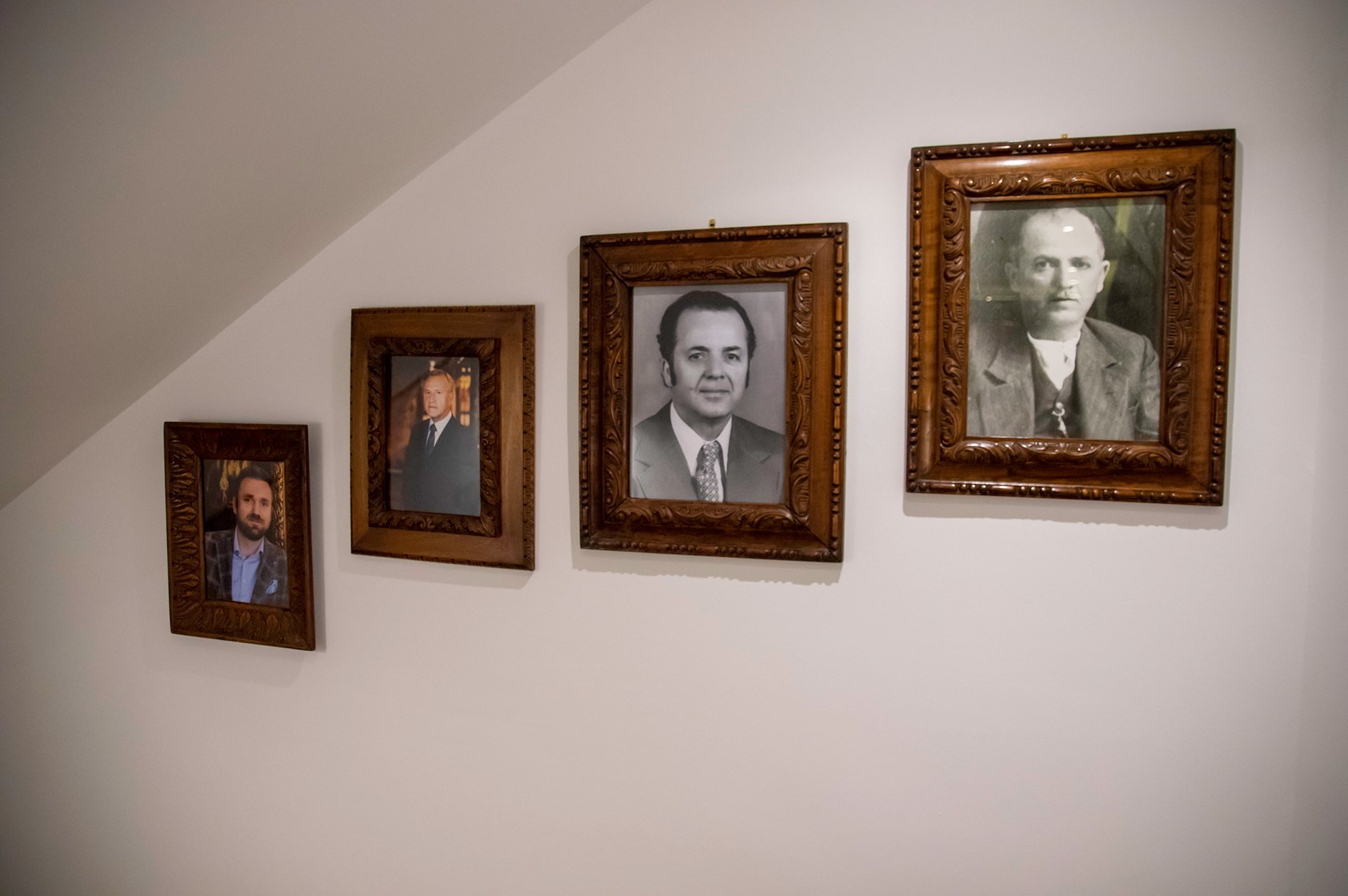
The Dereban family comes from Struga. The earliest known master is Evtinko Dereban, who is named in a document from 1819. His son Gjore learned the craft from him and kept a shop in the Struga bazaar. Since then the craft has passed from father to son for seven generations: Evtinko, Gjore, Nikola, Aleksandar, Vangel, Gjorgji and Nikola.
Aleksandar trained as a teacher, as did his brother Jakim. After he moved to Korçë in 1923, he went back to the workbench. The family has a saying from that time: whatever your profession, you should also practise the craft. Aleksandar later moved his family to Bitola, where he worked alongside his sons Vangel, Lambe and Nikola. He made the silver filigree butterfly that is now held in the Museum of Macedonia. In 1999 the film director Milcho Manchevski built the national “Made in Macedonia” campaign around it. At Manchevski’s request the hands holding the butterfly are Vangel’s. The other pieces shown in the advertisement come from the Dereban family and are now on display in our museum in Ohrid.
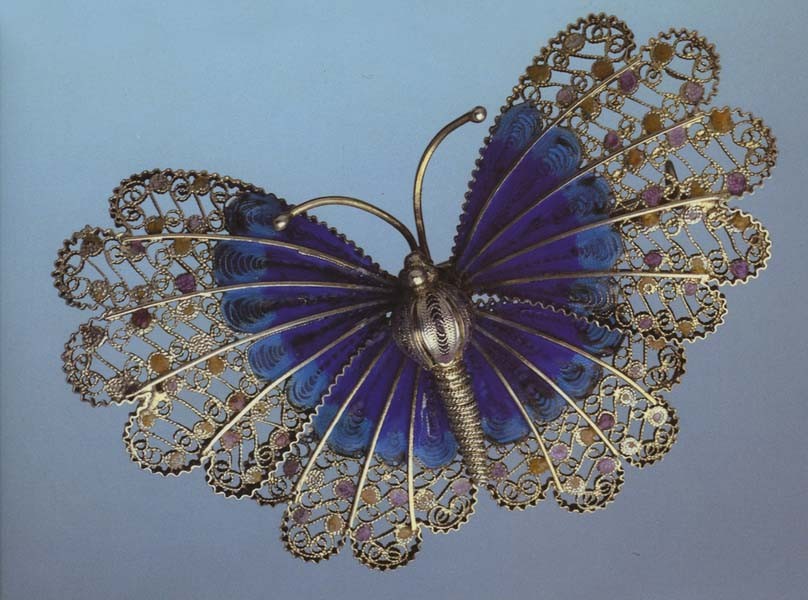
Silver filigree butterfly made by Aleksandar Dereban, now in the Museum of Macedonia. In 1999 it became the emblem of the “Made in Macedonia” campaign.
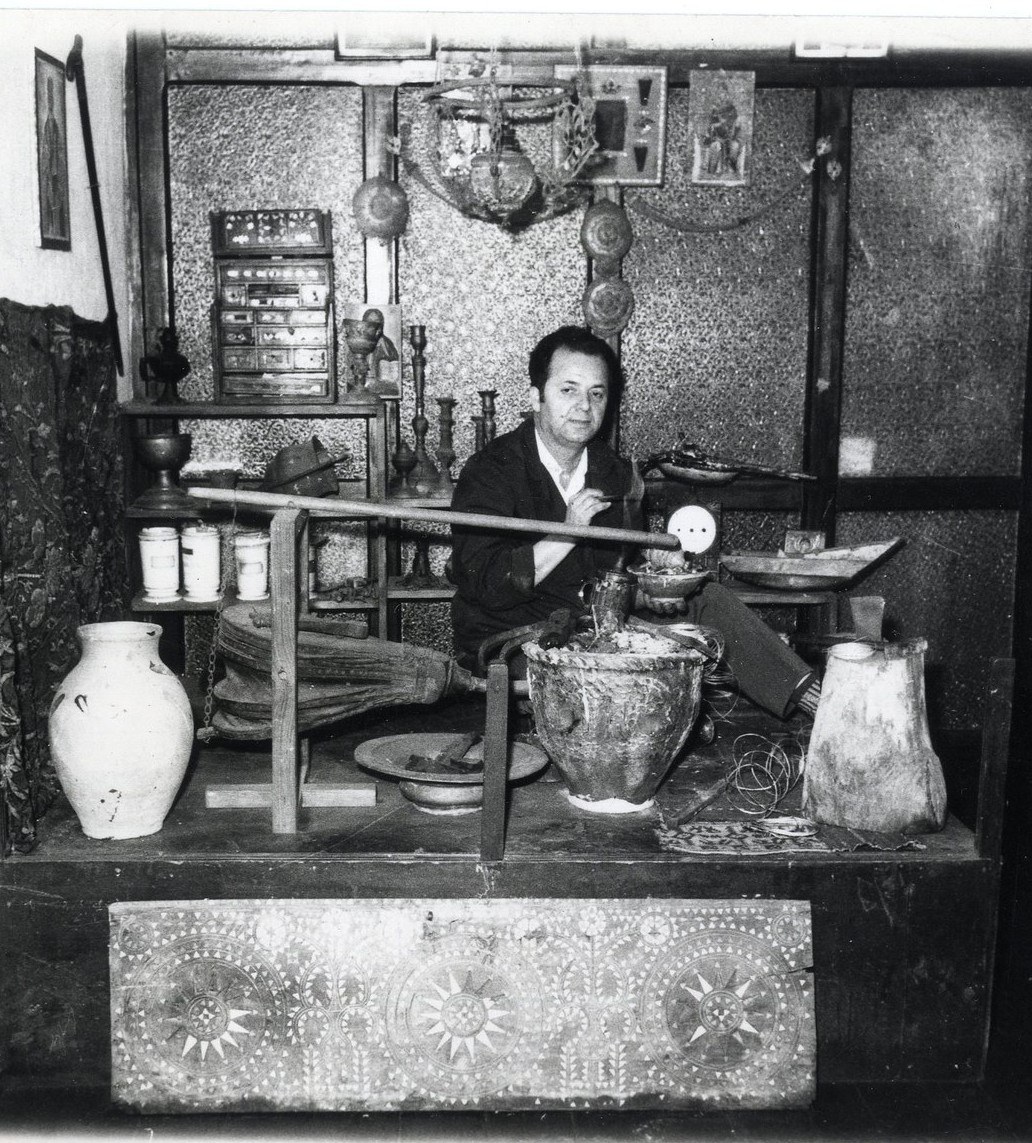
In 1962 Vangel moved with his family to Ohrid and opened his own shop. In 2021 his grandson Nikola restored the shop and opened the museum.
The wider family were goldsmiths too: Vangel’s brothers Lambe and Nikola, and Nikola’s son Tome, who has his own workshop in Bitola today. In other branches of the family were Gjore’s son Mitre and Mitre’s sons Igno and Petrush, and Slave Dereban, his son Mile and his nephew Jone.
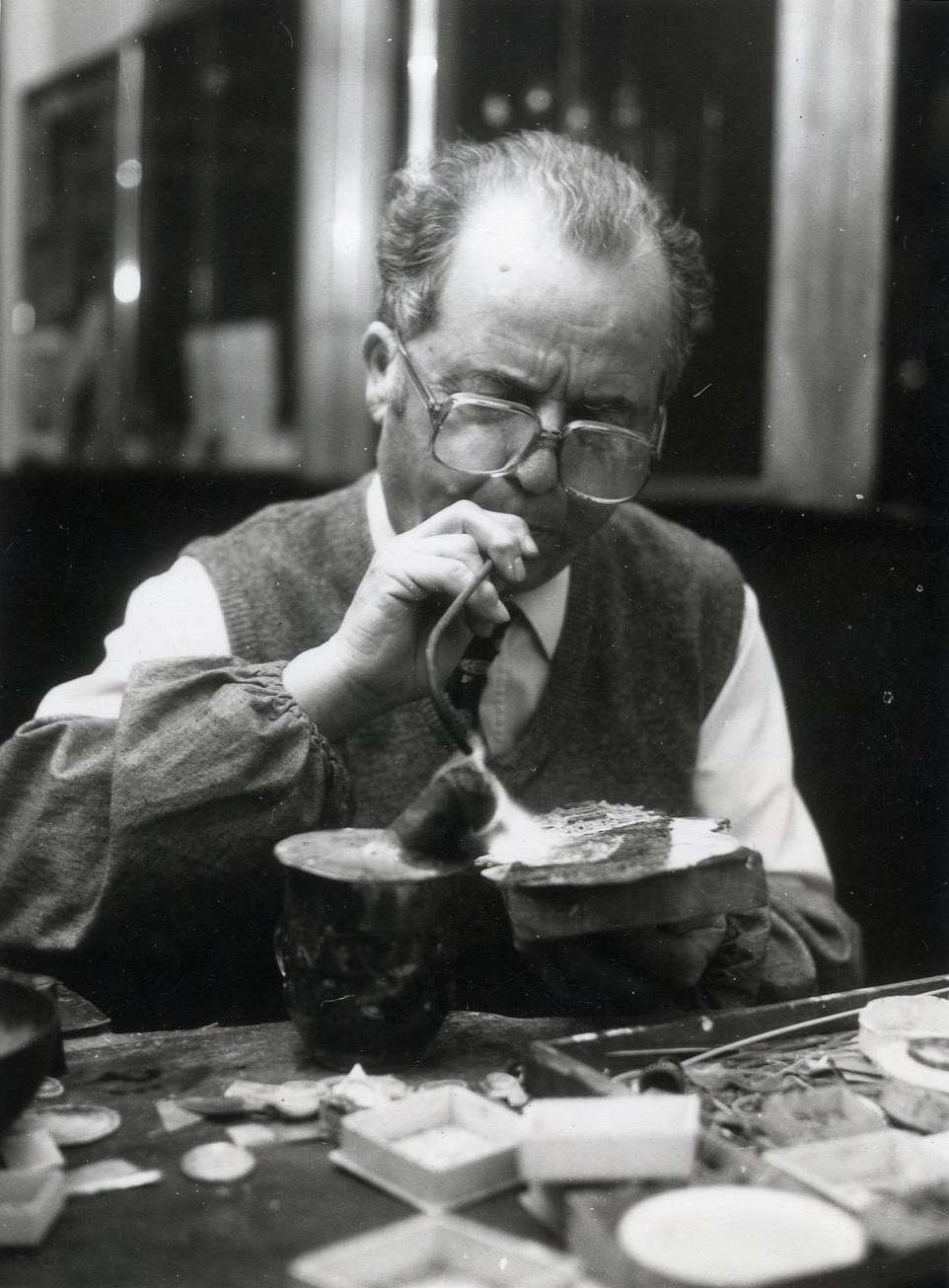
1920–2013
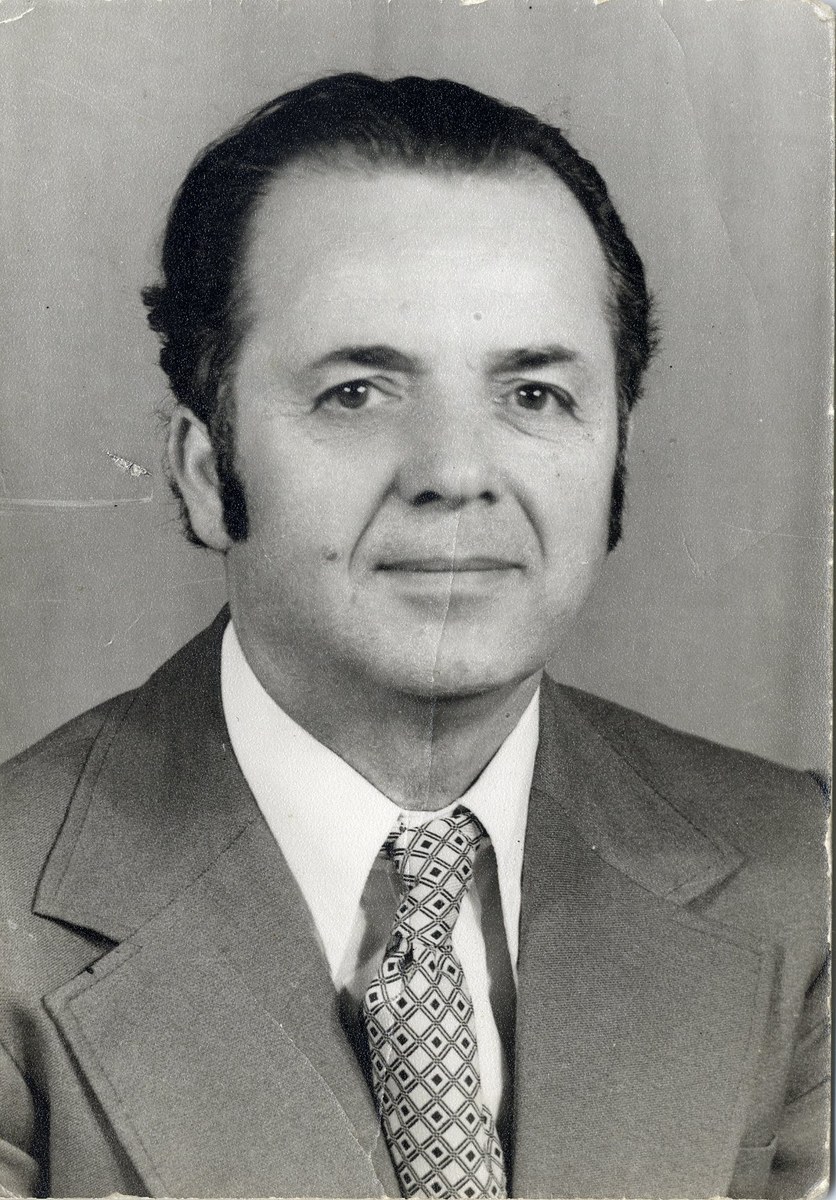
Vangel Dereban, the master
Vangel Dereban was born in Struga on 22 February 1920. His father Aleksandar had trained and worked as a teacher in Struga. In 1923, when Vangel was three, the family moved to Korçë, in Albania, where Aleksandar returned to the craft of his ancestors. Vangel grew up there, finished primary and technical secondary school, and learned filigree in his father’s workshop. In 1937 the family returned to Macedonia and settled in Bitola.
The road to his own master craftsman’s diploma was a long one; he received it in 1961. A year later he moved to Ohrid with his wife Ljubica, bought a house and opened his shop in the bazaar.
He loved to travel. He and Ljubica visited more than 60 countries together, and he came home from every journey with new energy for his work. He took part in exhibitions at home and abroad, including the “Days of Yugoslavia” in Amsterdam, and appeared on RAI Uno and on national television in Germany and the Netherlands.
In his shop he sold only what he made himself, often in front of visitors. From a single gram of silver he could draw a wire a kilometre long. Besides Macedonian he spoke Albanian and Italian, and also used German, which made his shop a meeting point for visitors from everywhere. He handed over every piece with a blessing (“wear it in good health”), thanked people who left without buying, and sent customers to other shops when he did not have what they were looking for. He would not let objects of historical value leave Macedonia: when he had to part with heritage pieces, he offered them first to Macedonian museums and institutions. “Our rare treasure should remain with us,” he used to say. A devout Christian, he never worked on church holidays and never charged for work he did for the Church. The Ohrid archaeologist Pasko Kuzman called the shop “an unfilmed Macedonian Manaki reel”, a place where the old goldsmiths’ bazaar of Ohrid still lived.
In 1997 Vangel published The Macedonian Jewellery, and in the same year the Economic Chamber of Macedonia named him among the laureates of its annual award. A bilingual Macedonian–English edition of the book followed in 2001, as did Bitola, the City of My Youth, which he dedicated to his wife Ljubica. In 2005 the city of Ohrid gave him the St. Clement Award, its highest civic honour. In his last years his grandson Nikola worked beside him in the shop.
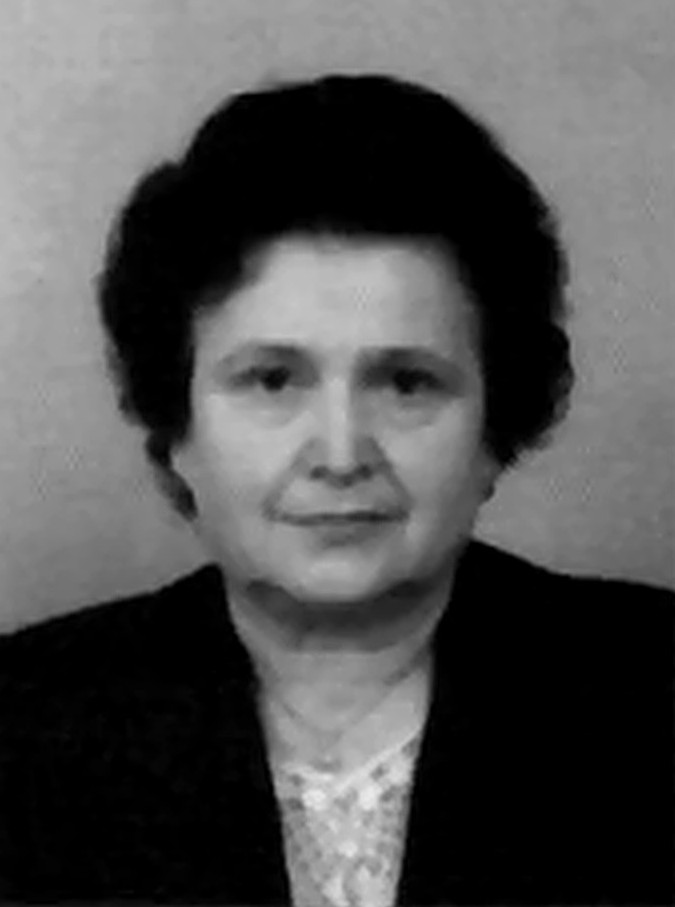
1931–2001
Ljubica Dereban
Vangel Dereban’s story would not be complete without his wife Ljubica. She was not only his faithful companion and support in the hardest moments, but also his assistant in the craft. Because she was raising their two children at the same time, and later helped with the grandchildren, few people knew that it was she, upstairs in the family home above the workshop, who carried out every stage of the goldsmith’s work.
Ljubica was born in Bitola in 1931 and went to school there. After the Second World War she lived in Ruma, in Serbia, where her parents ran a bakery, and worked as a clerk in the town administration. In 1951 she married Vangel. She travelled with him to more than 60 countries, and it was she who chose the pieces shown in The Macedonian Jewellery. Family and friends remember her as warm, open and kind. She died on 20 February 2001.
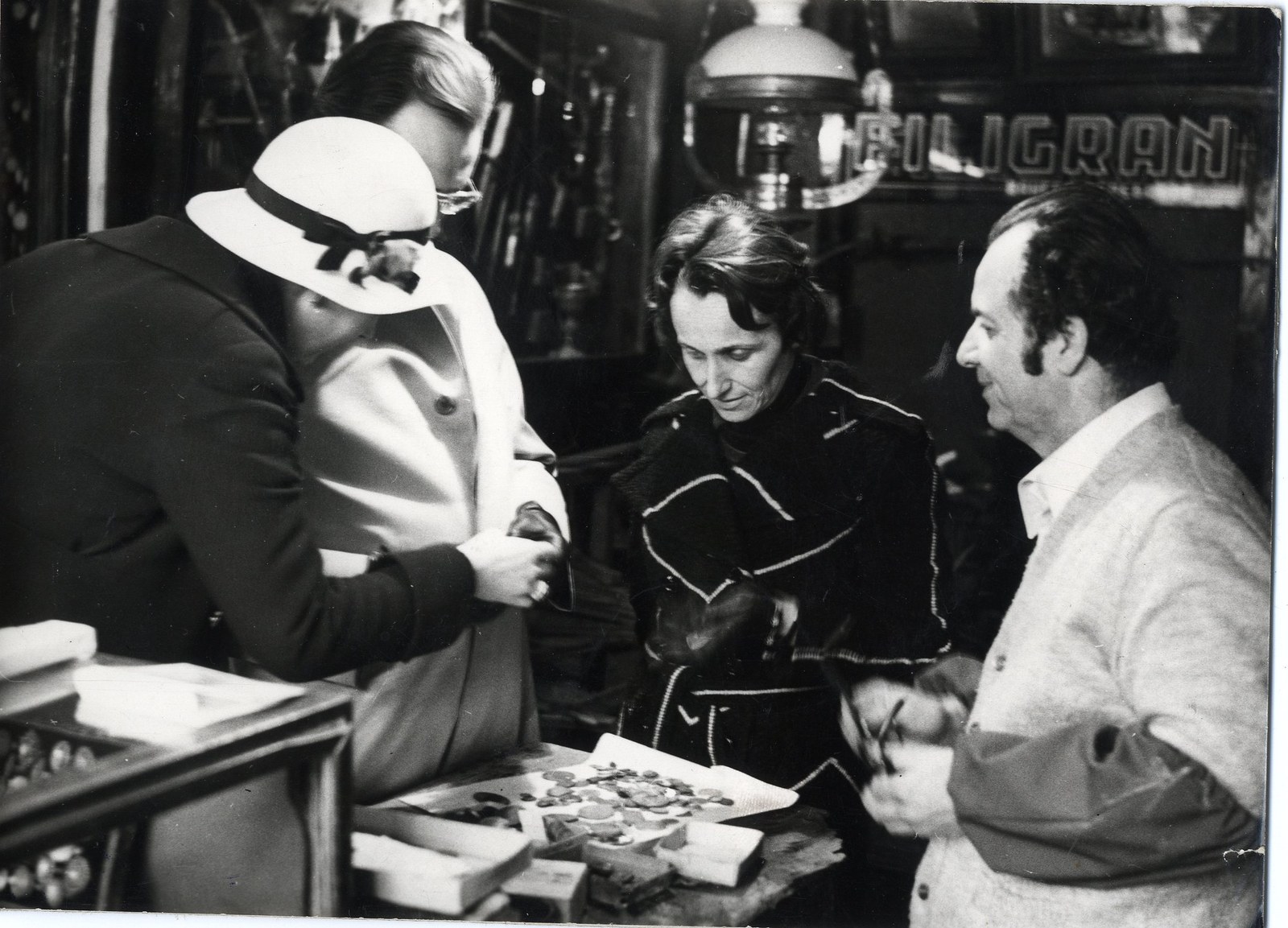
Queen Margrethe II of Denmark in Vangel’s shop, 21 April 1977.
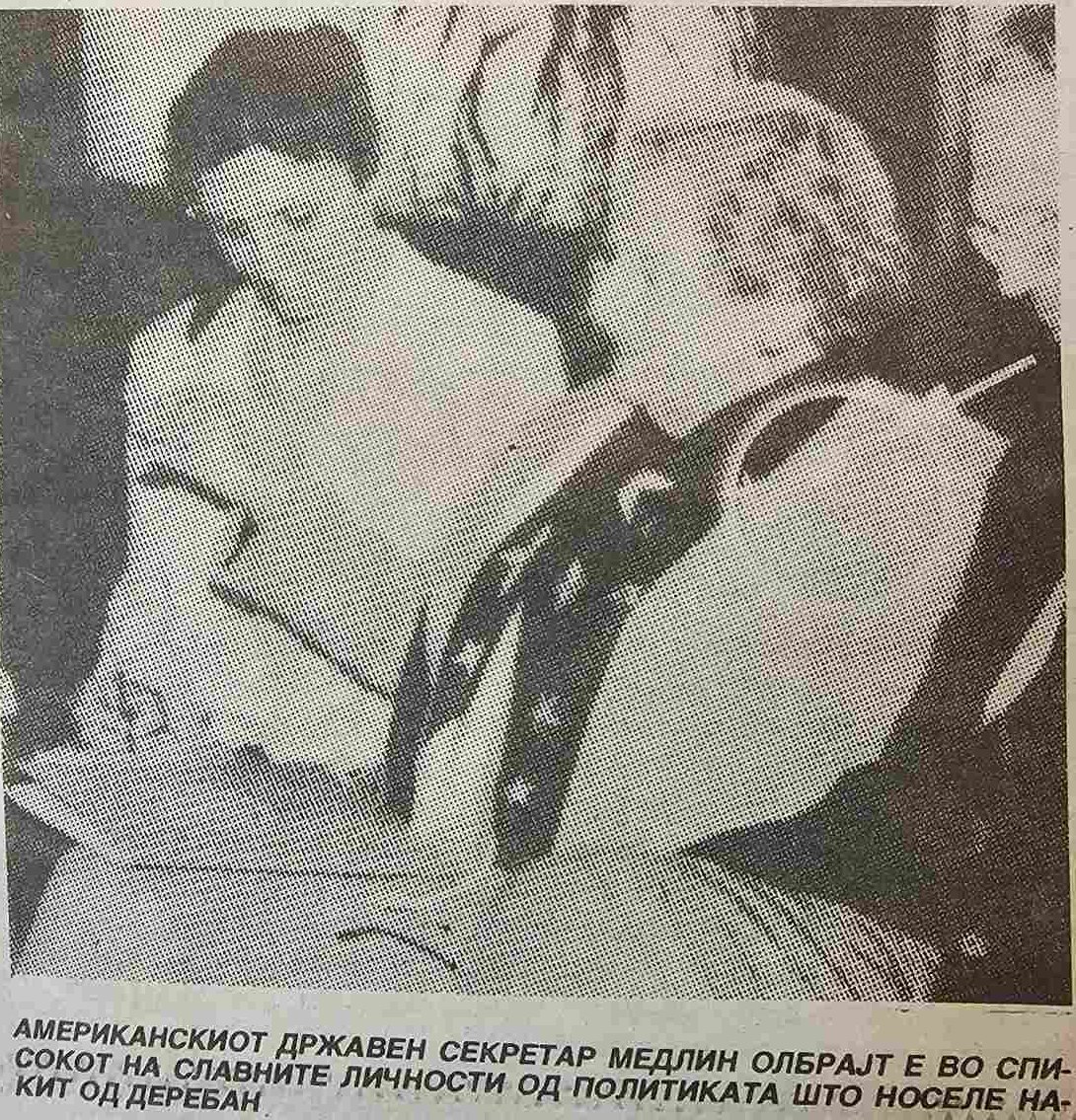
Madeleine Albright wearing Vangel’s brooch at the reception with President Gligorov, June 1999. Clipping from Večer.
21 April 1977
Visitors to the shop
On the afternoon of 21 April 1977, Queen Margrethe II of Denmark and Prince Henrik broke with protocol during their visit to Ohrid. Their motorcade stopped, unannounced, in front of Vangel’s shop in the bazaar. The Queen, a good judge of antiques, looked through his collection of historical pieces and asked him to show her how filigree is made. While she and her party watched him at work, Prince Henrik took a particular interest in Vangel’s old European coins.
The Queen chose a Macedonian pafta, the ornamental buckle brides wore at the waist for weddings and celebrations. As she left, Vangel gave her a silver spoon, a symbol of the vitality of the Macedonian home. “I wasn’t nervous,” he told a reporter the next day, “although it was the first time I had spoken with a queen, or given one a gift.” Months later he said what had struck him most was how much the royal couple knew.
In June 1999, during her visit to Macedonia, US Secretary of State Madeleine Albright was given a silver brooch set with Ohrid pearl, made by Vangel. It was the Macedonian government’s gift, presented by Foreign Minister Aleksandar Dimitrov. She pinned it to her lapel in the car, wore it to her meeting with President Kiro Gligorov, and kept it on for the rest of her visit. The government also gave members of a Taiwanese delegation handmade silver cufflinks from Vangel’s shop. Among those who visited the shop itself were the American statesman Robert McNamara and Italy’s minister of culture.
Visitors left their impressions in his guest book. One wrote: “Only golden hands could master silver like this.” Another: “You and your craft are a great treasure for Macedonia.”
Sources: Večer, 22 April, 23 April and 2 August 1977, and 14 June 1999, p. 2; Lejla Sabit, “Златните раце на Деребан”, Večer; Stojan Risteski, Златните раце на Вангел Деребан (Struga, 2003), pp. 17–23 and 41.
2021
The museum today
“With him I made my first ring, which we kept as a present for my future wife. When I was in high school we added the corals, and a few years ago I put it on her hand.”
— Nikola Dereban, grandson
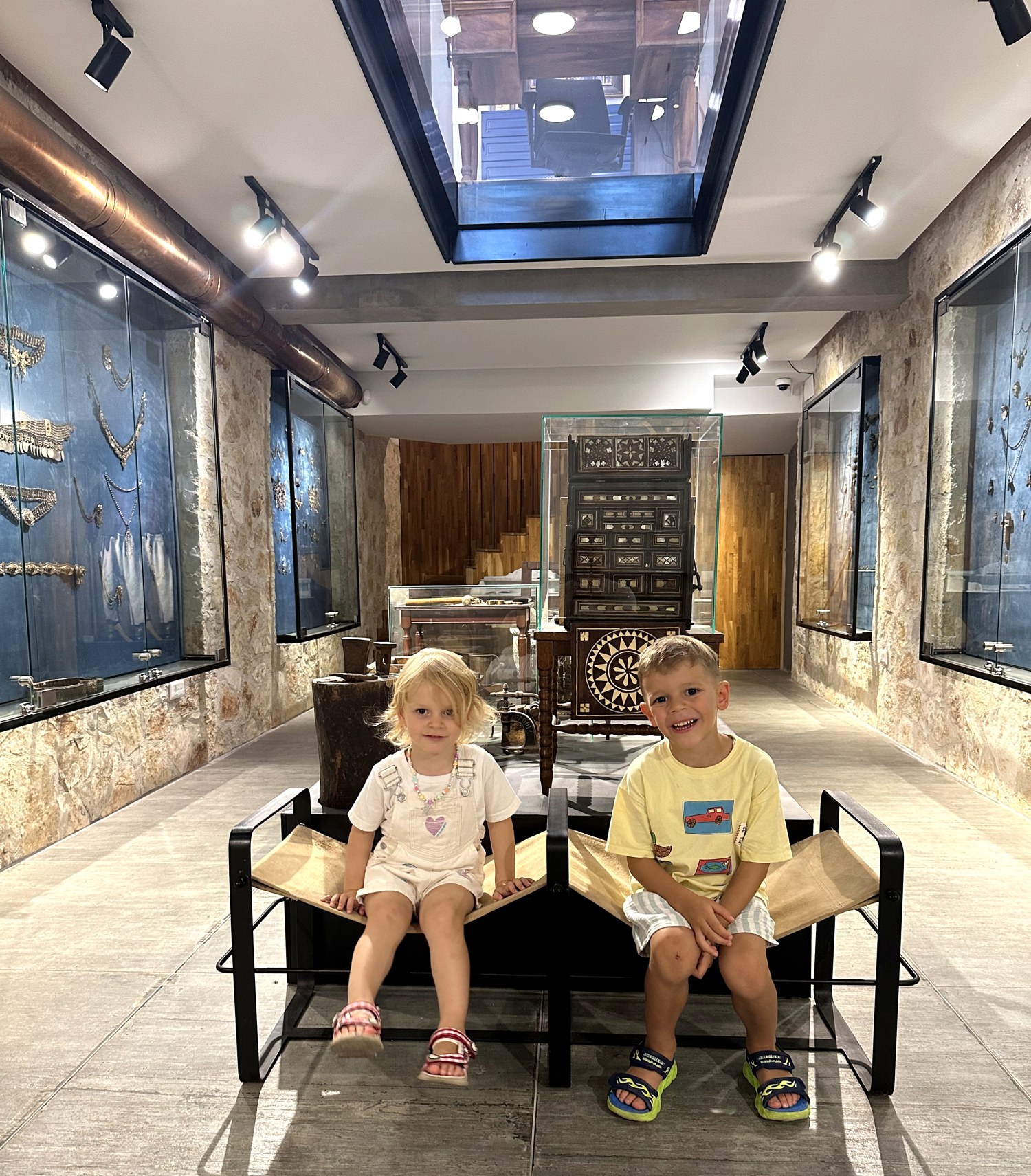
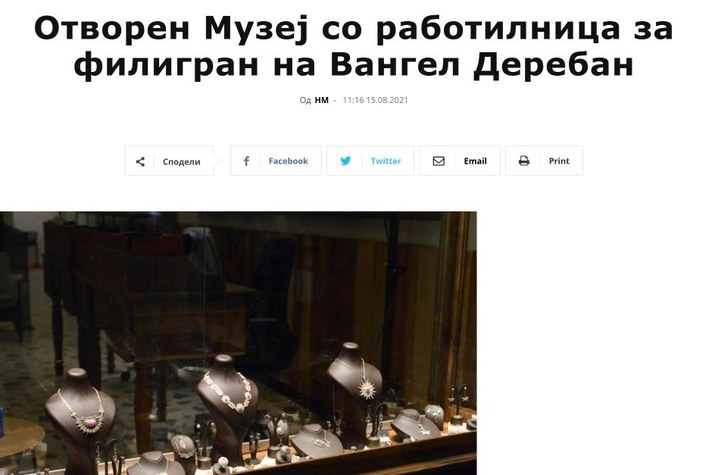
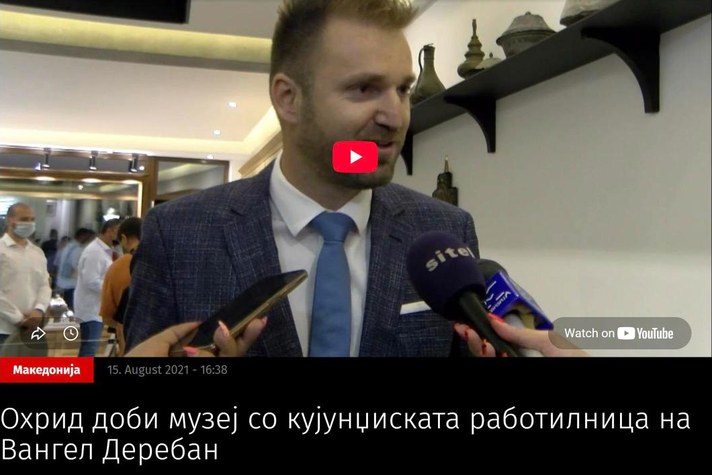
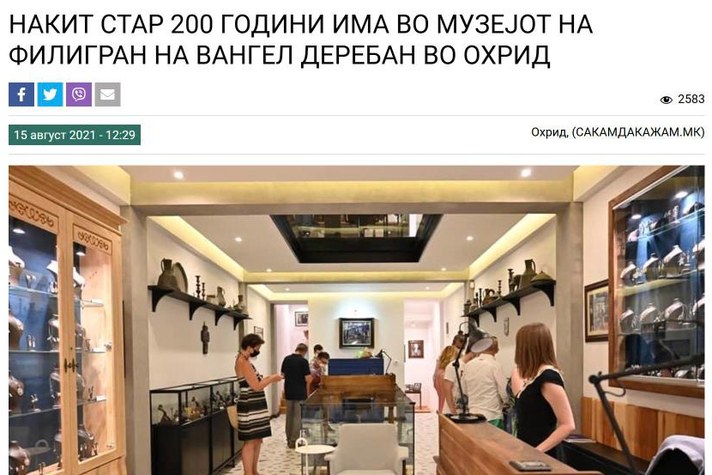
On 14 August 2021, in the year Vangel would have turned 101, his grandson Nikola restored the shop in the bazaar. He also restored Vangel’s old bellows and the hand-cranked tool he used to draw silver wire thinner. Both are now on display in the museum downstairs, with the family’s tools, jewellery and silverware.
The museum has six displays, five of women’s jewellery and one of men’s, with pieces up to 200 years old in silver and gold, set with precious and semi-precious stones. The new edition of The Macedonian Jewellery was presented at the opening.
In literature and media


In the press
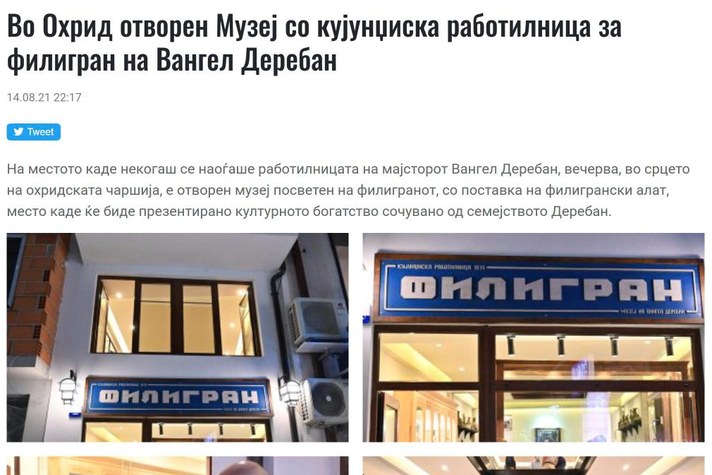
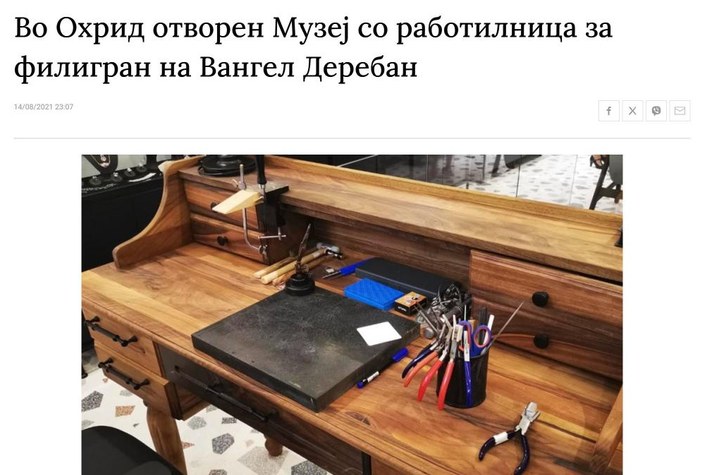
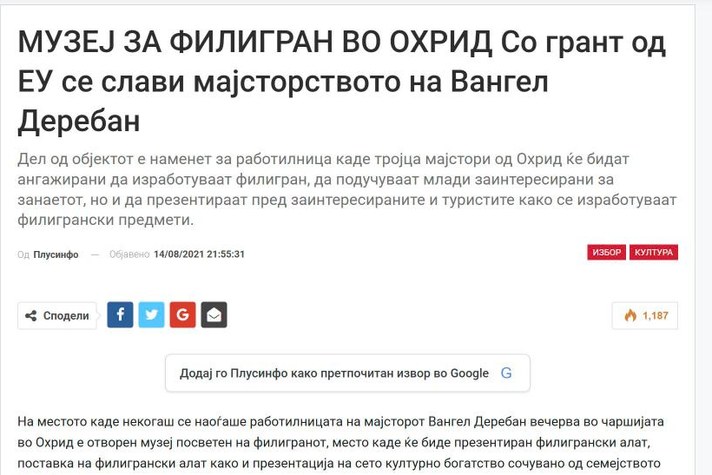
The opening, 14 August 2021
Reports on the opening of the museum (in Macedonian).
The book
The Macedonian Jewellery
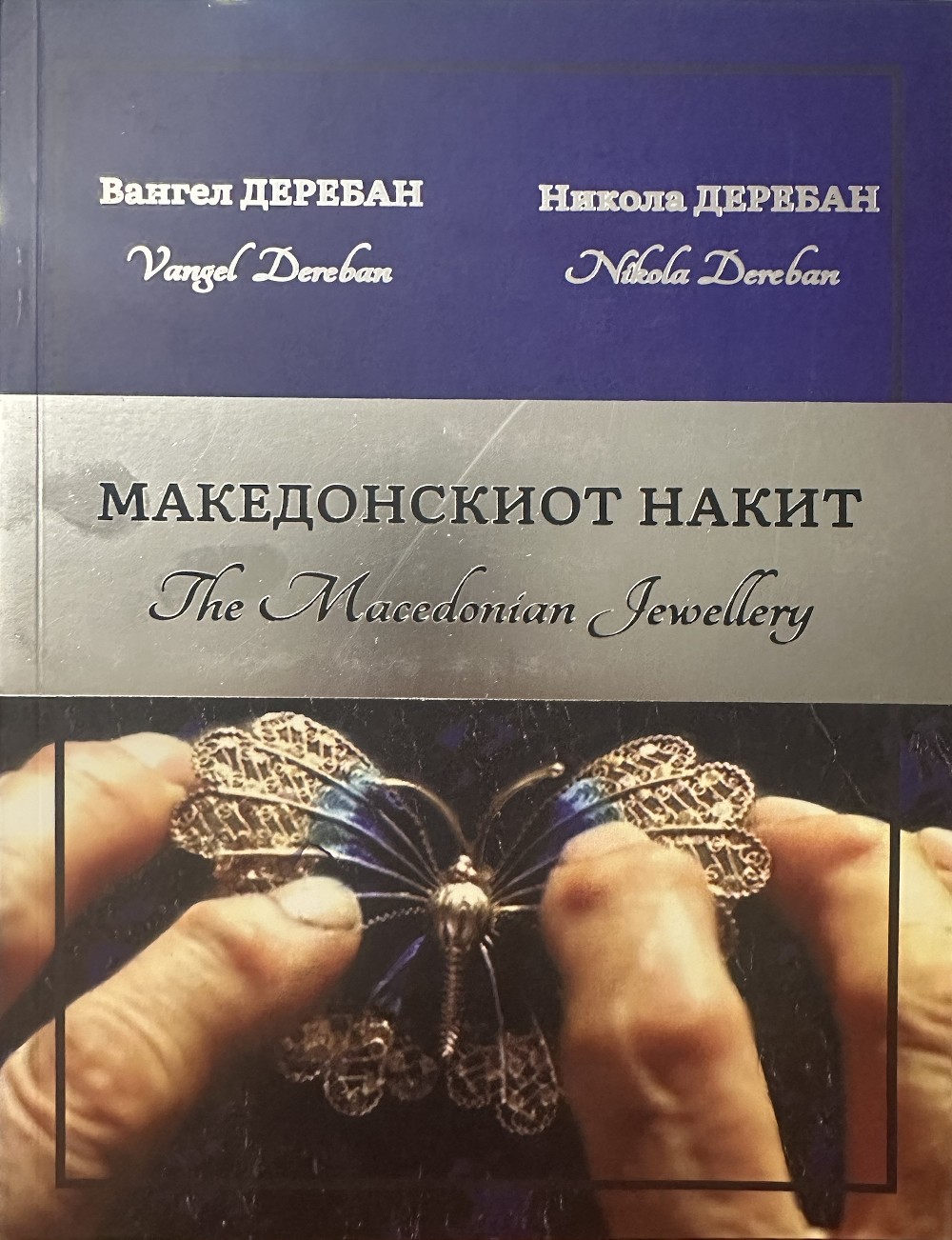
Written by Vangel Dereban and reissued in 2021 with his grandson Nikola as a bilingual Macedonian–English edition. It covers the materials, tools and techniques of the craft, the symbolism and protective power of jewellery, and silver made for homes and churches, illustrated with the family’s own collection.
The cover shows Vangel’s hands holding Aleksandar’s butterfly, a still from the 1999 campaign.
Available in the museum shop.
Contact
Location
MUSEUM OF FILIGREE – “VANGEL DEREBAN”
St. Clement of Ohrid 40
6000 Ohrid, North Macedonia
+389 71 321 462